Saturday, February 05, 2011

this is why we have a subscription

Magical Dinners is right. Korean food, Thanksgiving memories, subscribers only! I loved this, especially the part about licking the mini blinds.

Vanity Fair/Sanity Air. Just in time for Valentine's day, a love letter from James Wolcott to NPR. Wolcott puts a finger on why so much NPR (ie, Ira Glass) bugs me - no spleen! But then he moves on to the good stuff. He calls our attention to "a feminism so integrally wired into the basic circuits that it can be taken for granted, until you start listening/watching/reading someplace else." Yes, it's a seventies feminism, but it's very important. And there's something very nice about the way he segues to reflecting on this feminism from his discussion of NPR as a sound medium.

And I just read the Munro story about the pair of college sweethearts.

Labels:

Monday, June 21, 2010

eat me

Elif Batuman, "Letter from Istanbul, The Memory Kitchen." From the abstract: "The writer notes that food has never played a large role in her mental life, but that night at Çiya, she viscerally understood why someone might use a madeleine dipped in tea as a metaphor for the spiritual content of the material world."

Read more: http://www.newyorker.com/reporting/2010/04/19/100419fa_fact_batuman#ixzz0rVWEPd5c

I really wanted to read an article about food in Istanbul. When the author admitted that she wasn't that interested in food herself, I was intrigued. When she made the ol' Proust reference, I put down the magazine. Enough already.

But really, how cool is this? In a food essay! "I get so confused by nutritional, budgetary, ecological, ethical, aesthetic, and time-managment concerns that I often subsist for weeks on instant oatmeal and multi-vitamins." Maybe I'll try again now that I'm better rested and less testy.

Labels:

Saturday, February 13, 2010

The sociology of drinking: newyorker.com

The sociology of drinking: newyorker.com

New Haven, Bolivia, Italian-Americans, diaries. Gladwell.

Labels:

Wednesday, February 03, 2010

corny c.1986

I liked Seabrook's tribute to Salinger, but it was the only one I read.

Benj wants to see more cats represented in the New Yorker's artwork.

Labels:

Tuesday, January 05, 2010

whole foods, boy bands, grace kelly and the UC system

Three profiles and some bad news. Now that's a New Yorker. Something about each and everyone of those topics.

Paumgarten goes over the Mackey basics for people who don't already avoid Whole Foods. From where I sit, he's trying to be even-handed, but the very last paragraph seems entirely dismissive, like something you'd write about someone who you are very glad to see go:
Talk turned to food, as it often does. “You only love animal fat because you’re used to it,” he said. “You’re addicted.” He urged me to consider reprogramming my palate. He also suggested that I try Grofian breathing.

After a moment, he got up to leave, and I watched him walk toward Sixth Avenue, in a suit that looked a size or two too big, thinking, or not thinking, about what he was going to say on the Fox Business channel.

Read more: http://www.newyorker.com/reporting/2010/01/04/100104fa_fact_paumgarten?currentPage=all#ixzz0blAMmSpS

The thing about boy band Vampire Weekend (well, not that kind of boy band, but still) was a little more indulgent. Like their older sister wrote it. I bristled at the quote from bandmember Koenig: "There are probably a lot better reasons why you could say we're not good." Sooooo smart he knows better than you do what is wrong with the particular brand of wool he's pulling over your eyes. But this profile also included a pithy paragraph of disdain, but this time from a quoted source, rather than the author. Pitchfork said:
"The image they project is practically The Darjeeling Limited brothers of indie rock bands - globe-trotting sons of distinguished men clumsily exploring distant cultures, despite only being passively, naively invested."
And Pitchfork's readers said: "It's like the Whiffenpoofs started a ska band." Eeek.

Anthony Lane on Grace Kelly is hilarious and kind of meta when he explains the concept of "the Chinese whisper, whereby [a biographer] quotes somebody who quotes somebody who knew the subject in question." The things folks said about Grace Kelly (naughty and nice) were only somewhat interesting.

And Tad Friend's letter from California, about the crisis in the UC education system, was useful, timely and much more important than the other items mentioned here . . .

Labels:

Tuesday, August 05, 2008

talk of nettles. and thistles. and other things to eat.

You did read "Fourteen Passive-Aggressive Appetizers," didn't you? Oh, delicious.

And "Soup to Nettles," one family's experiments in 19th C Russian cookery. Also tasty.

The Emdashes interns are right, hip-hop Sesame Street is sublime. I also liked both Sasha Frere-Jones' posts the price of soul at the Christies' auction of James Brown miscellany. One sounded a bit like a good Talk; in the other, a picture spoke a thousand words.

The end was a bit pat, on Frere-Jones' longer piece (and the Russian one, for that matter), but that's how Talks are, huh?

Well, maybe not. The end of "Kranking It" was quietly dismissive in the best way.

Rebecca Mead's nuptial Talk was alternately seductive and repulsive. I got confused when the now-divorced Ms. Tucker is describing her wedding ceremony:

"'My dog Rosy was in the wedding. She wore a thistle collar. It was very me.' Was it also very him, she was asked. Tucker paused. 'I have no idea,' she said. 'Herein lies the problem.'"

The first two times I read it, I thought the him was the dog Rosy. The gender of dogs escapes me, I fixate on the weird psychological shit people put their pets through, I don't know . . . Anyway, when I went to post today, I realized the him in question was probably the ex-husband.

But the absolutely most disgusting line the whole thing is this, "The couple have been engaged since before Niederhoffer was pregnant with Magnolia but have no immediate plans to marry." Ew. Just ew. If you live in a world where you feel you have to be explicit about the dates, just . . . never mind.

To quote Tucker, “It’s like the perfect bohemian existence, except not.”

Labels:

Thursday, July 03, 2008

a case of the giggles

Even if you usually skip such things, you might want to read Lauren Collins' review of the much-maligned restaurant Ago in the July 7&14 issue. She carefully and methodically works up to the kind of cliched pun that smacks you silly with its utter brilliance.

I also loved this:


And I'm a big fan of Anu Garg's A.Word.A.Day (thanks, little-brother-who-gives-the-greatest-gifts). Recently they used a funny quote from Anthony Lane to demonstrate the not quite medicinal use of the word "costive." Check it out.

Labels:

Thursday, December 06, 2007

on having it both ways

White Bread and The New Yorker, a visualiterary pun. I like to think that the creative people at Sara Lee have most deliberately created a public meditation on consumer culture and the historical construction of "taste" that addresses the material, visual and gustatory sensorium.


The heads up (and a charming excuse that mentions the ever-controversial BLT) came to me from Emdashes, the image comes from something called MarketingProfs Daily Fix.

Best of all, you can find this work of art and social commentary at a grocery store near you.

Labels:

Monday, November 19, 2007

Double Takes

In the November 19th issue. Lauren Collins (twice), Richard Brody, Larry Doyle and, of course, David Denby (twice).

Best line in the whole magazine, in "Why We Strike" - "Management is currently offering us adjusted bubkes of what they are making off Internet sell-through, streaming, ringtones, Webisodes, cellisodes, iPodisodes, celebrity-narrated colonoscosodes, or the psychotic episodes they've been beaming into your brain, brought to you by Clozaril." (51)

My emphasis. When I regained my breath, I realized that that's how you spell bubkes.

I liked Lauren Collins on the restaurant Taim. Not gushing and a little ironic, "You get the feeling she spends a lot of time at the Container Store," but positive. And she nicely manages the contrast between the attempt to "make gourmet food 'street'" and the yummier ambition, to "take street food, and make it gourmet." She sets it up and doesn't belabor it. And maybe it helps that I'd actually like to eat the food she's describing. (19) Or maybe that's the intended effect of a good review.

Apparently Ethan Hawke is playing a "not very bright kid brother" in a Sidney Lumet caper. Excellent. (26) Thank you, David Denby!

Richard Brody says some smart things about Griffith, Murnau and Eisenstein. Except that thing about Eisenstein as the cinema's "first modernist" . . . that's a bit much. (30)

Lauren Collins' "No Seconds" on the famous last meal thing is, fortunately, in extremely bad taste, since it appears while there is a moratorium on executions in the US. And dull into the bargain. And, just for the record, I would never, EVER buy Secret Ingredients, The New Yorker Book of Food and Drink which is advertised, oh-so-conveniently, on the next page.

Skipped Jon Lee Anderson's latest installment in the adventure serial he's working on.

I valiantly read pages and pages of Pierpont's essay on Orson Welles and Laurence Olivier. My favorite part was "Oliver then insures that the film is too unnaturally beautiful ever to be confused with reality."(72) That's Henry V (1944).

John Lahr doesn't love Mel Brooks' Broadway adaptation of "Young Frankenstein" and admits, "These are hard words to write." Really? (88)

But the biggest surprise of the issue has got to be this: Brian De Palma's new film Redacted, set in midst of the violence of the Iraq war, is actually about film critic David Denby's media habits. Check it out.

Labels: , , ,

Wednesday, September 26, 2007

who looks funny?

I hate the cover of the style issue. To the point where I might tear it off and throw it away. Sometimes funny and fashion don't happen.

Sometimes they do; I kept up a steady chuckle reading Henry Alford on the solar panelled jacket. That's just the abstract.

The article itself opens with "History has not been kind to garments that serve a function other than that of keeping their wearers warm or unnaked or adorable." Too true.

And yet, I think he's right in his enthusiasm for the solar panels in his new jacket. I think that there is a secret desire that clothes should become more like computers and bikes and our bodies and DO something. They have too much to-be-looked-at-ness so to speak. Fashion isn't even, usually, 3 dimensional enough, for god's sake.

The only other Donatella Versace profile I ever read was in TNY - when and by whom? And why does Lauren Collins not even mention that it's been done? Or does she? I lost interest.

Basics, but as usual so smart. James Surowiecki. On fasion, copyright, and the capitalist temporality of the trend.

And what else is news?

Electic Warrior is reading the NYT Sunday Style Magazine, or at least looking at the pictures, and thinks you should too.

The Determined Dilettante isn't reading that rather dull thing about olive oil, is reading something interesting from Mark Singer, which is in an issue of TNY that I misplaced.

Juniper Pearl's abiding love for TNY is tested by Adam Gopnik's drive to eat local.

Kitchenography entertains the Live Chicken! fantasy (past the recipe).

Sepoy declares, "I am sticking to not-reading NYT’s editorial page." Or did declare this in a heated moment.

Labels:

Tuesday, September 18, 2007

picky eaters

My mother, NOT the only person I know who makes unintentional pastry-themed puns, described much of the September food issue of The New Yorker as "fillers" and "fluffy."

But she recommended the Claudia Roden article and so I read it and now I recommend it too. I especially like it when the author presses the point with Roden about what actually makes a recipe authentic. (103)

I also liked a short portion of McPhee's article, about a diet of edible wild plants. (87-88)

And I liked the beginning and end of Acocella on the Dante translation. When she was talking about the actual translation, and the notes. (127 & 131-33)

I loved (not in the food issue, but relevant) John Seabrook, "Annals of Agriculture, Sowing for the Apocalypse, The creation of a global seed bank" about the politics and history of monoculture and seed banks. Aug 27 (60-71)

In that same issue was the sort of unsatisfying Alex Ross on Copland, which ended beautifully, when it stopped trying to be so historical. (40)

And Paul Goldberger's "Retro Opulence on Central Park West" had a lot of zingers.

My mother also thought Thurman's colonic spa thing was a testament to what is wrong with the world today. I read it first thing.

And, if, as Emdashes' link suggests, Gopnik's essay in the food issue was him implying that other people are "privileged, nostalgic and naive" I definitely have to read it.

Labels:

Monday, May 14, 2007

break for lunch


Reading Terminal Market
Originally uploaded by canine devotion.
As you know, sometimes I set down my magazine and wander into the kitchen. Thus, Lindy's invitation, that we share our favorite portable snack, really got me thinking.

Ever since my parents decided that the school lunch* was a basically non-toxic time-saver for busy families, I've been happy to eat out a midday meal. Benj has all kinds of persuasive arguments about not reinventing the wheel, and divisions of labor and I tend to buy them. Lunches, I mean. In some times and places, street food or eating out or not cooking everything from scratch are less fraught than in others. And Philadelphia c. 2000, where and when I once held a 9-5 library job, was one of these less-fraught settings.

But even then, one summer when I was really trying to save money, and house-sitting in the 'burbs and commuting through Reading Terminal to my 9-5 job I came up with this little number:

The Very Resourceful Tomato Sandwich

- 1 absolutely fresh New Jersey tomato from Reading Terminal. Keep a knife handy. Transport the tomato in a plastic tub that will keep it from turning to mush in your bag.

- 1 packet of mayo begged, borrowed, bought or stolen from the Convenient Food Store.

- 2 slices of wheat bread toasted in the library's break room toaster.

- salt from the library's break room salt shaker.

The library also had an amazing roof deck attached to its perfectly standard break room, where I ate this sandwich. Sometimes I added cucumber.

*One of the school lunches was chicken noodle soup, half a PBJ and half a banana. My mother - who, as a treat, let me open the alfalfa sprouts when I wanted a snack while she was shopping - wasn't big on the dishes that people call comfort food so this is odd little combo, served institution style, was and is my comfort food. I used to make variations on it when I came home late at night in my teenage years, which leads me to one of my favorite things about the word "lunch," that it once meant a small meal at any time of day.

Other lunches I like to take include green beans and chick peas marinated in vinaigrette and tomato bread salads.

And the lunch I most frequently bought was from the aforementioned Convenient Food Store in the bottom of the big apartment building on the corner of Broad and Spruce. It's a veggie hoagie - hold the mayo, with oil and vinegar and that bizarre mushy white american cheese. It's divine and a fair bargain. [It's now my profile pic lots of foodie places.]

Also note: Mrs. Delicious on the delights of sandwiches you "eat over the sink."

I first learned about the existence of tomato sandwiches from Harriet the Spy. A book in which the household had both a (famous) live-in nanny and a (less famous) cook who made lunches and provided cake and milk.

Reading Terminal photo comes from canine_devotion at flickr. Veggie Hoagie is all mine.

Labels: ,

Wednesday, April 04, 2007

3 thoughts on Mayo

I had but two consolations to sustain me.

First, a Mayonnaise of chicken of my own making on the luncheon-table, which, as a work of Art, was simply adorable - I say no more. Secondly, my green silk dress, trimmed with my mother's famous lace - another work of Art, equally adorable with the first. Whether I looked at the luncheon-table, or whether I looked in the glass, I could feel that I worthily asserted my nation; I could say to myself, Even in this remote corner of the earth, the pilgrim of civilisation searching for the elegant luxuries of life, looks and sees - France supreme!


(Madame Pratolungo in Wilkie Collins, Poor Miss Finch, 189) Click to enlarge photo and see such a work of Art.

The sauce was invented as a new sensation for jaded palates at court by the duc de Richelieu, at first known as mahonnaise after Mahon, the chief port of Mincorca, the scene of the duc's dubious 'victory' in 1756 over the illfated Admiral Byng. Basically Louis's drug dealer and pimp, Richelieu, known for opium recipes to fit all occasions, is also credited with the introduction of into France of the cantharides, or Spanish fly. [...] What might this aphrodisiac have in common with the mayonnaise? That the beetles must be gathered and killed by exposing them to vinegar fumes suggests an emphasis on living or recently living creatures - the egg yolks perhaps regarded as a conscious entity - cooks will speak of whipping, beating, binding, penetration, submission, surrender. There is an undoubtedly Sadean aspect to the mayonnaise. No getting past that.

(Pleiade Lafrisee in Thomas Pynchon, Against the Day, 545)

I also, recently, made James Beard's excellent crepe recipe - 3 eggs: 1 c milk: 1 scant c flour.

Labels: ,

Thursday, November 09, 2006

chicken alas a dirty word

"They stopped in Charlottetown and had dinner. Emily, who had had no appetite since her father's death, could not eat the roast beef which the boarding-house waitress put before her. Whereupon Aunt Elizabeth whispered mysteriously to the waitress, who went away and presently returned with a plateful of delicate, cold chicken - fine white slices, beautifully trimmed with lettuce frills.

'Can you eat that?' said Aunt Elizabeth sternly, as to a culprit at the bar."

LM Montogomery, Emily of New Moon, Ch.6

***

I've said some mean things about pale, measly chicken before myself, but now that I am preparing organic chicken breasts I find them way more flavorful, rich, and, oddly reliable in their soft, slippery, sweet, firm texture. My musings were brought on by chicken thoughts at Eat and at Food+Paper, recently.

Whenever I enjoy chicken, I think of it as above. It's a fascinating quote; it's a description of inedible chicken that is still somehow quite tantilizing . . . The passage is really even more fraught, but I didn't want to quote too long. And Aunt Elizabeth, after all, Emily finds, has more tang than Aunt Laura. So not to worry. Cousin Jimmy has been haunting my academic work lately, but that's another story.

I like pork and lamb and beef a lot too, but let's not fault healthy, simple chicken breast just because agricultural industrialization made it all injected and rubbery and weird.

And another party heard from. Gertrude Stein, Tender Buttons, Food.

***

WAY LAY VEGETABLE.

Leaves in grass and mow potatoes, have a skip, hurry you up flutter.

Suppose it is ex a cake suppose it is new mercy and leave charlotte and nervous bed rows. Suppose it is meal. Suppose it is sam.

COOKING.

Alas, alas the pull alas the bell alas the coach in china, alas the little put in leaf alas the wedding butter meat, alas the receptacle, alas the back shape of mussle, mussle and soda.

CHICKEN.

Pheasant and chicken, chicken is a peculiar third.

CHICKEN.

Alas a dirty word, alas a dirty third alas a dirty third, alas a dirty bird.

CHICKEN.

Alas a doubt in case of more go to say what it is cress. What is it. Mean. Potato. Loaves.

CHICKEN.

Stick stick call then, stick stick sticking, sticking with a chicken. Sticking in a extra succession, sticking in.

***

That was hard to excerpt. I knew where to end this one, but when I tried to figure out where to start, well, you know . . . And I take back what I said about visual representations of Alice Toklas. There is an enchanting photograph of her in this week's New Yorker.

Categories: , , , ,

Labels:

Tuesday, November 07, 2006

healthy, nutritious education

"Education at the Dewey School was based on the idea that knowledge is a by-product of activity: people do things in the world, and the doing results in something that, if deemed useful, gets carried along into the next activity. In the traditional method of education, in which the things considered worth knowing are handed down from teacher to pupil as disembodied information, knowledge is cut off from the activity in which it has meaning, and becomes a false abstraction. One of the consequences (besides boredom) is that an invidious distinction between knowing and doing - a distinction Dewey thought socially pernicious as well as philosophically erroneous - gets reinforced . . .

One of Dewey's curricular obsessions, for instance, was cooking. (Like all courses at the school, including carpentry and sewing, cooking was coeducational.) The children cooked and served lunch once a week. The philosophical rationale is obvious enough: preparing a meal (as opposed to, say, memorizing the multiplication table) is a goal-directed activity, it is a social activity, and it is an activity continuous with life outside the school. But Dewey incorporated into the practical business of making lunch: arithmetic (weighing and measuring ingredients, with instruments the children made themselves), chemistry and physics (observing the process of combustion), biology (diet and digestion), georgraphy (exploring the natural environments of the plants and animals), and so on. Cooking became the basis for monst the science taught in the school. It turned out to have so much curricular potential that making cereal became a three-year continuous course of study for all children between the ages of six and eight - with (on the testimony of two teachers) 'no sense of monotony on the part of either pupils or teacher.'"
(322-3)

This from Louis Menand's The Metaphysical Club, chapter 12, titled "Chicago" . . .

Labels:

Friday, October 20, 2006

questions posed to our techno-gustatory memory

From : "thethriftiestgirlinla" <-----@---.edu>
Sent : Thursday, October 19, 2006 9:59 PM
To : -------@hotmail.com
Subject : one small jar

What does one do with one small jar of berry preserves that are best
before 10/15/06?

Should one make a linzertorte with the preserves? Or is there another
alternative?

xo "the thriftiest girl in LA"

P.S. My friend Aaron thinks that "in the soup" is a domestic version of
"in the shit" which originates from army-speak.


Apart from eating a lot of scones and jam, maybe with cheese, or chicken sandwiches with preserves or hosting a brunch with these items, I didn't have anything to suggest other than the linzertorte. But if you've got any ideas, post them here, quick, before her jam goes bad. Does jam go bad? Suddenly?

But this email provides the opportunity to post the recipe I use for linzertorte. Ever since I once posted a photo of said European dessert item, searches for linzertorte bring a lot of hits here. Note: I've been keeping an eye on my searches, but nothing very funny has been searched. Oh, except this: "what kind of offensive language does nancy drew books use?"

I keep the recipe in an email from my little brother.

From : "mylittlebrother" <--------@surfree.com>
Sent : Saturday, December 25, 1999 3:47 PM
To : <-------@hotmail.com>
Subject : linzer torte

hey ----, here's what the book says:
1 cup butter, softened, Pinch of salt
1 cup sifted confectioners' sugar, 1/2 teaspoon cinnamon, 1 egg, 1 egg
white
Grated rind and juice of 1 lemon, 2 3/4 cups sifted all-purpose flour,
1 1/2 cups rasberry jam or currant jelly, 1 1/2 cups ground hazelnuts or
almonds, confectioners' sugar

beat butter until creamy; beat in sugar to a fluff, add the egg, beat
until frothy; then add flour, nuts, salt and cinnamon. Chill
thoroughly, then roll out two-thirds of the dough large enough to cover
the bottom and sids of a 9-inch round cake pan, preferably one with
removable bottom. Brush egg white over the bottom; let dry. Roll out
the remaining dough, cut into lattice strips. Blend the lemon rind and
juice with the rasberry jam or currant jelly, spread this filling over
the pastry dough. Place the lattice pastry strips over the top. Bake
in oven preheated to 400 F for 45 minutes. When torte is removed from
oven, immediately sprinkle top with confectioners' sugar. Spoon
additional jam into squares formed by the lattice if filling has shrunk
noticeably. Makes 6 to 8 servings. chow and ciaou


In other news, almost 24 hours after I saw some fresh figs I involuntarily remembered with whom (and where) it was that I got into an argument about what the fruit on my plate was. It was a fresh fig and it was a grad student at a kind of fancy with an invited speaker dinner. A few days ago the thriftiest girl in LA was describing fresh figs over the phone and I knew I'd gotten in a fight with someone over fresh figs but the details escaped me.

Don't mention the m-word. How hilarious is this? I added Carolita Johnson to my sidebar because, really, in addition to being a New Yorker cartoonist she regularly posts a short, pointed digest of the week's New Yorker articles. And she keeps an ongoing "Tables for One" log: the tale that precedes the post linked above is also absolutely darling.

And when I saw Chungking Express for the second time last week I realized that although I remembered parts of the movie, I could have sworn the pineapple plot was entirely new to me. I saw this film for the first time the year before my little brother wrote me the above email.

Categories: ,

Labels:

Wednesday, October 18, 2006

vegetable perception

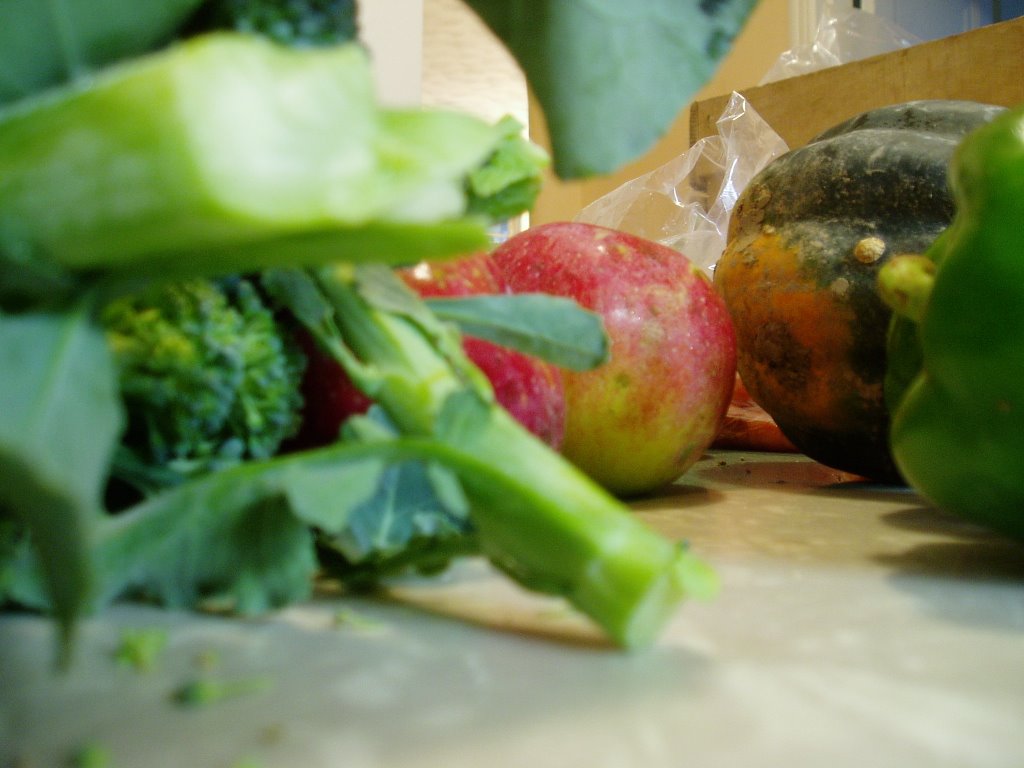
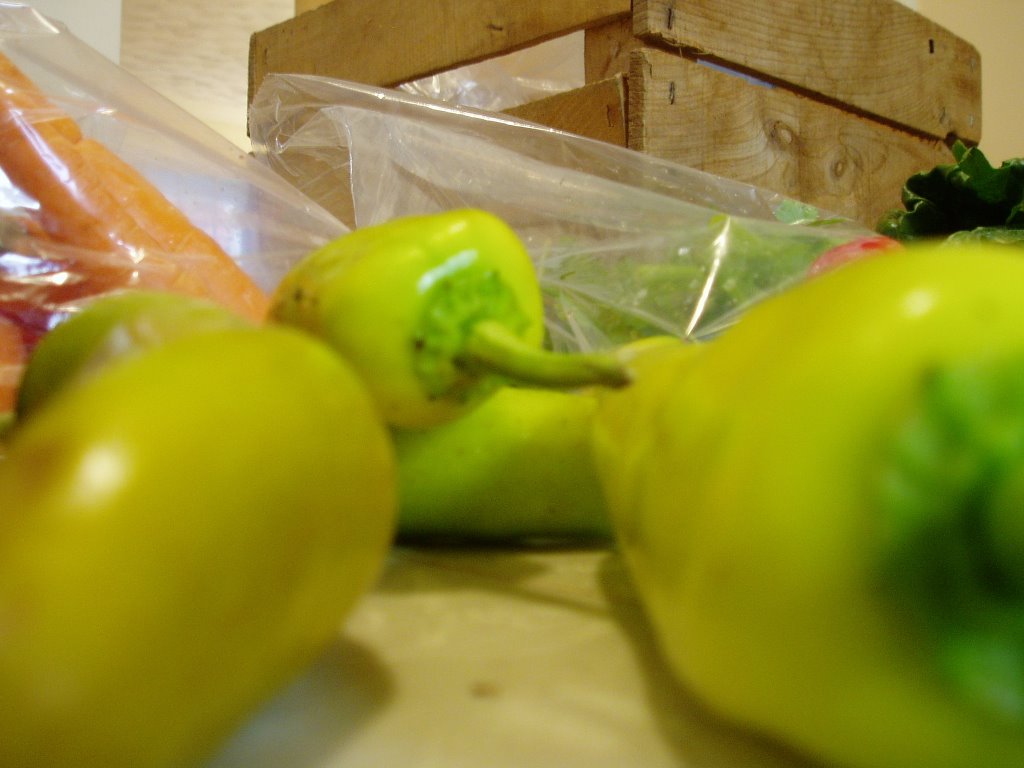
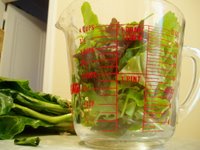
I really enjoyed meeting everyone at Whole Foods and I'm sure the library will put my 5% to good use. I thought I'd post quickly to give everyone the web address for The Kretschmann Farm delivery and some veggie photos. For a more comprehensive view of what's in the box this week, go to my flickr photos.

And, as long as I'm wearing my sometimes food blogger hat I thought I'd post a recipe I've referred to at Kitchenography (thanks for asking!) and Eat and probably elsewhere too, the meatless Mushroom Moussaka from The New M--sewood Cookbook. While it may be against the law to publish this recipe here, Katzen would do better to chase down the Martha Stewart's Everyday Food staff, who routinely copy her recipes. Unless she's sold them to Everyday Food, in which case I say all's fair.
Without further ado, Mushroom Moose-aka.

1. Slice 3 medium eggplants into 1/4 inch rounds. Salt them and layer them in a colander, or between towels. Stand 20-30 min.

Meanwhile, start the mushroom sauce.

2. Cut 2 lbs mushrooms into quarters, at least, or smaller if that's your style. Heat 2 tbs olive oil your tomato sauce pot. Add 2 c onions and salt, and cook over med heat until the onions are translucent. Don't rush this. Add mushrooms and garlic, cover and cook 10 min or so.

3. Add 14-20 oz of tomato, some paste if you've got it, fresh if you want, whatever. Adjust your cook time accordingly.

4. Add 1 tsp or more cinnamon, black pepper to taste, 1 tsp each basil and oregano. Bring to a boil then simmer at least 15 minutes. The recipe calls for 1/2 c breadcrumbs and 1/2 c parm at this stage but I don't add bread unless I've got something sitting around that really wants to go in. And I usually throw in my parm rinds, which I keep for the purpose of making sauces. Do they teach you this on TV? Well, do it. Add 1 c packed fresh minced parsley.
Let the sauce cool and return to your sweaty eggplants. I wipe them now.

5. Lightly oil a baking sheet and pop your eggplant slices in the oven at 375 F for 20 minutes.

Now, for the not really Bechamel at all.

6. Fill your vintage 4 c Anchor Hocking measuring cup with 2 c milk and heat in the microwave. Or whatever.

7. Heat nice and hot 3 tbs olive oil in a small sauce pan.

8. Drop, one by one, stirring to a slurry, 6 tbs flour into the hot oil. Let it brown, let it stick a little, but don't let it burn. I've done this with a fork, or a whisk. You can turn down the heat as you go. When the flour paste is a nice dark yellowish tan, lift the sauce pan off the heat and cool it a moment.

9. Then pour in the milk, with the heat off, or low. Stir till smooth.

10. Keep the heat low and leave the sauce with 1/2 c feta or parm. Stir occassionally, don't let it scorch, wait for the cheese to melt and the whole thing should become smooth. I add a few whole cloves of garlic here, and a good pinch of nutmeg. And salt. All together now.
11. Put a double layer of eggplant in a casserole dish, or two, or whatever fits. Cover with mushroom sauce. Then a single layer of eggplant. Then the not-Bechamel.

Bake uncover'd in the 375 F oven for 30-45 minutes.

Making 2 sauces and cooking the shit out of the eggplants (why this dish works at all) can be a little athletic - you might get breathless but don't lose your concentration - it's part of the Pittsburgh winter triathalon, along with shoveling snow. Let me know if I've left out any details; I'm not very experienced at plotting this kind of thing. Good with green salad.

Categories: ,

Labels:

Tuesday, October 10, 2006

public library, corporate charity

As if I weren't already conflicted enough about Whole Foods, nutrition, public insitutions (I know the CLP is totally complicted funding-wise) and private charity now this promotion. Whole Foods is giving 5% of next Wednesday's profits to the Carnegie Library of Pittsburgh. Heads up, Pittsburgh food bloggers and library users.

UPDATE: Informal meet-up of Pittsburgh's more or less informal food bloggers. Wednesday at 1 PM. Coffee and whatever else you feel comfortable eating at Whole Foods.

Categories: ,

Labels:

Friday, October 06, 2006

buford on the food network

From the Oct 2 Issue, Bill Buford on "TV Dinners, The Rise of Food Television" As you probably know, I don't have cable, so my knowledge of this phenomenon is fleeting, or second hand. And, duh, I think the food sounds nasty. So maybe I'm not Ray's best defense. But . . .

On Rachel Ray: "a likable sales-rep personality, with a me-and-my-mom vocabulary." (45) I'm not sure what this means, exactly. But does it have something to do with that trend diagnosed by (among many, many others) Teen Vogue, the mom as best friend thing? Only more down home?

I don't actually think it's that new. When you're out and about in Pittsburgh you often run into mother-daughter pairs gabbing their hearts out in intimate ways made possible, I think, only by close geographical and emotional proximity. And somehow the moms then know all about the daughter's jobs and family life and all. I think this might be what Buford is talking about . . . and it's key.

Only I'd say it's more than a vocabulary . . . and let's just say that for geographical, economic, personal and political reaons most of the people I'm closest to (who may or may not have passed on Rachel Ray's trash bowl tip to me) don't have this with their moms. . . at least not regularly, or dependably.

On the Audience: The network was now in seventy-five million households and its audience was among the most affluent people watching television in America. 'And nearly half of our viewers are men,' Girard said. This was a different audience from the one conceived by Schoenfeld, and rather elusive to picture. I found myself imagining stock traders and dot-com millionaires at home all day, kneading dough, trying out new recipes, wondering what to do with the saffron. (45)

I think this last is a bit dismissive and wilfully obtuse. For one, Girard (the Food TV pres, I think) claims that her audience is the most affluent TV watchers, not the most affluent Americans. And what's so funny about well-to-do men learning to cook, Bill Buford? He of all people.

Why is so hard for Buford to imagine that there might be men, and women, who, perhaps lack some kind of easy old-fashioned me-and-my-mom relationship, but want a little guidence (maybe even guidence they don't entirely buy and enjoy feeling superior to?) in the kitchen? I don't want to argue that the Food Network is a surrogate mother, but I think it probably fills a niche that other kinds of learning (home ec?) used to fill, and it offers this learning to a wider, less strictly gendered audience . . .

To her credit, the inclusion of the story about Julia's early on-air omelette suggests that she understood food TV this way too and (to his credit) that Buford understands that she understood food TV this way.

Maybe Buford commentary on the Food Network would have been more interesting in a less formal form, like, as mzn suggested, blogging. But you know what he could do given the resources, etc of the New Yorker? Write a short history on the following:

Ours is a different audience from the one that watched Julia Child. In 1962, “microwave oven” and “fast food” hadn’t entered the national lexicon. And restaurants were more expensive. Tim Zagat, the publisher of Zagat Guides, points out that for more than two decades the cost of going to restaurants or getting takeout has risen less than the annual rate of inflation—that it’s much less expensive today than at any other moment in our history to pay other people to prepare our dinner. Never in our history as a species have we been so ignorant about our food. And it is revealing about our culture that, in the face of such widespread ignorance about a human being’s most essential function—the ability to feed itself—there is now a network broadcasting into ninety million American homes, entertaining people with shows about making coleslaw. (47)

The very interesting thoughts that close the article.

But I love the description of Julia: Child, too, was unlike anything else on television: six-feet-two, virtually hunchbacked, seeming too ungainly for a small screen, with a long, manly face, but one that was also remarkable for its intelligent expressiveness. (44)

And if you're wondering why there are horseradish photos on my flickr, well, I was provoked by the smartypants at Epifurious. They plan to post on Buford's Food TV experience too and I'll link when they do.

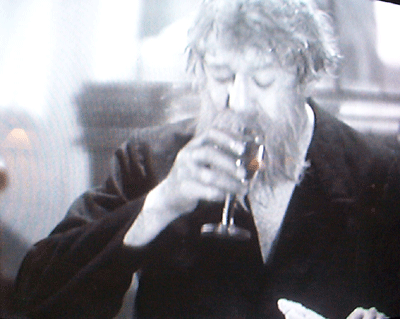
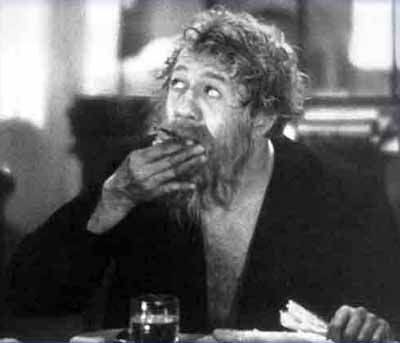
The images here are of brilliant, beautiful Michel Simon in Boudu Saved From Drowing/Boudu Sauve des Eaux (Jean Renoir, 1932).

Categories: , , ,

Labels:

Wednesday, October 04, 2006

with bonus cinematic culinary metaphor

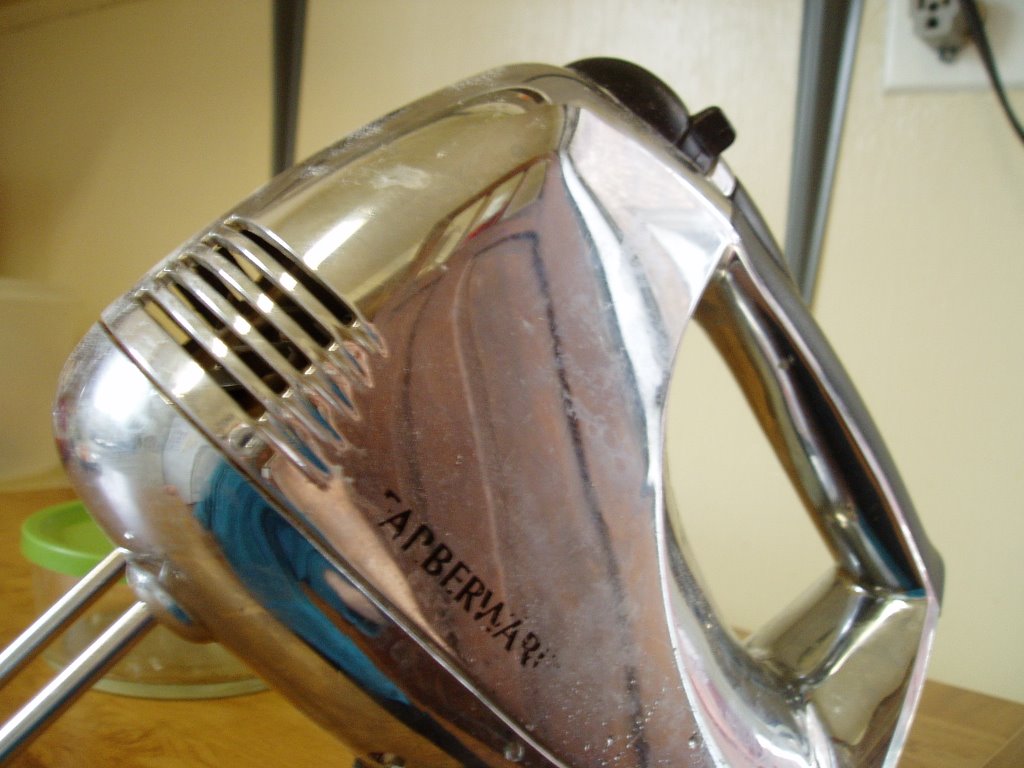
This one works the other way, the kitchen as understood through the film: "a Hobart mixer with a vaguely menacing air, like the hooded mother beast in Aliens." (73)

This quotation is from the same article (discussed below) which, by the way, was quite erroneously titled, "The Lunchroom Rebellion, An haute-cuisine chef goes back to school." Unless by "rebellion" they mean when the kids refused the spelt and veggie pizza and wrote Cooper that "petition." (77) If by "rebellion" they mean Cooper's crusade or military coup or whatever they should say so. Never mind the legal and religious connotations of "petition" . . .

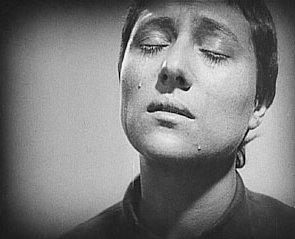
And surely they mean Alien 3, where the alien is at it's most hooded and metallic? Ann Cooper wishes she was as tough and heroic as Ripley. And as misunderstood as Falconetti. But she is so not.


Categories: , , , ,

Labels: